

Microsoft has announced a significant architectural shift for Copilot in Outlook, elevating the tool from a reactive assistant into a fully autonomous agent capable of managing enterprise communications without direct user prompting.
Rather than waiting for commands to draft emails or summarize threads, the AI now actively handles routine tasks in the background, a move that signals a broader industry push toward agentic AI in productivity software.
The update enables Copilot to perform complex, multi-step workflows based on simple user-defined instructions, providing transparent action logs so professionals can review, adjust, or override decisions at any point.
Microsoft Copilot in Outlook
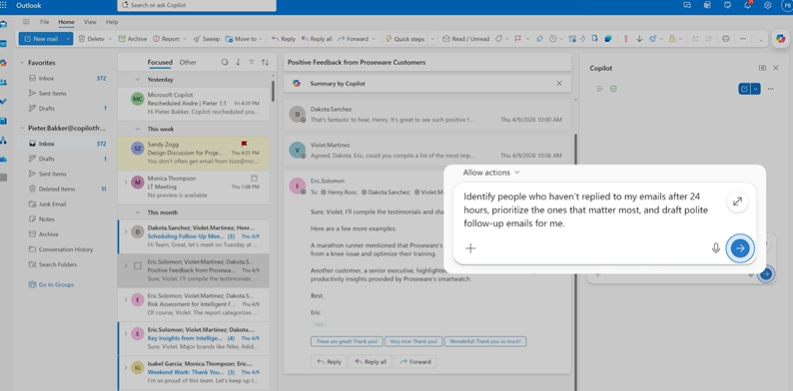
These new capabilities officially launched through the Microsoft 365 Frontier program on April 27, 2026.
Corporate inbox management has historically required continuous human attention to sort incoming messages, flag urgent items, and ensure timely follow-ups.
Copilot now assumes this workload autonomously, surfacing high-priority communications and organizing clutter before the user even opens the application.
Key autonomous inbox capabilities include:
- Identifying unresolved email threads after 24 hours and automatically drafting polite follow-ups
- Pulling project updates from the past week to draft confidential briefing emails for management
- Creating dynamic inbox rules that assign high-priority categories to direct messages from leadership
- Summarizing missed communications during vacations, including safe-archived items and outstanding urgent tasks
These features are currently rolling out across all Outlook endpoints, making them broadly accessible to Microsoft 365 enterprise subscribers.
Beyond inbox management, Copilot now extends its autonomy to calendar operations, an area that traditionally requires significant cognitive overhead to maintain.
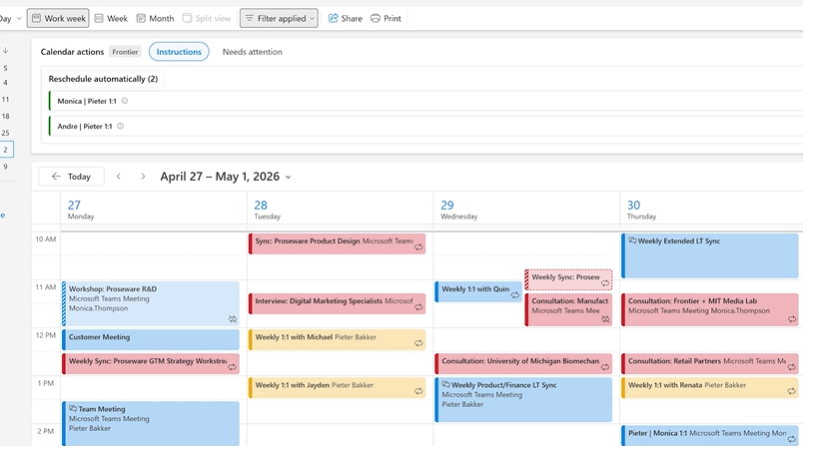
The system continuously monitors the user’s schedule and acts on custom preferences to negotiate meeting times, rebook conference rooms, and block dedicated focus periods without manual intervention.
Advanced calendar delegation features include:
- Automatically resolving double-booking conflicts for recurring meetings
- Applying rules to follow large meetings outside standard working hours asynchronously, rather than attending live
- Shifting blocks of internal meetings to designated days to preserve deep-work time
- Analyzing upcoming schedules to recommend which invites to decline, delegate, or handle asynchronously
- Gathering relevant context and identifying potential risks ahead of upcoming client calls
These advanced calendar tools are currently limited to Outlook for Windows and the web client, with broader endpoint support expected in subsequent rollout phases.
Security and Governance Implications
As AI agents gain deeper, persistent access to enterprise communications infrastructure, the security implications extend well beyond productivity gains.
Copilot’s ability to autonomously read, draft, categorize, and act on sensitive organizational email introduces new considerations around data governance, insider threat modeling, and access control.
IT and security teams will need to evaluate how these automated actions interact with existing Data Loss Prevention (DLP) policies, eDiscovery requirements, and conditional access frameworks.
An AI agent that can draft and archive confidential briefing emails or autonomously apply inbox classification rules creates an expanded attack surface if compromised through prompt injection or misconfigured permissions.
Microsoft’s transparency layer, which logs AI actions for user review, provides a baseline control mechanism.
However, organizations operating under strict regulatory frameworks or financial sector compliance mandates, should carefully audit how agentic Copilot features align with their data handling obligations before broad deployment.






No Comment! Be the first one.