
Cyber defenders are losing the race against zero-day exploits not because they lack skill, but because the sheer volume of code and alerts has made manual review unsustainable. OpenAI is betting that artificial intelligence can permanently close that gap.
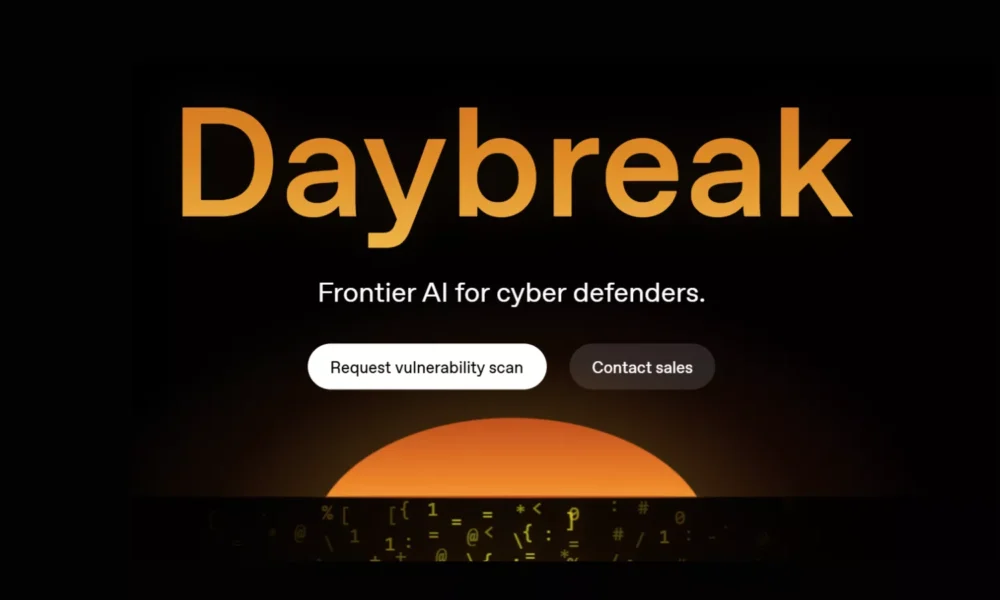
Unveiled as a frontier AI system built exclusively for cyber defenders, OpenAI Daybreak reframes the security equation entirely.
Rather than treating vulnerabilities as post-deployment problems to patch reactively, Daybreak embeds resilience directly into the software development lifecycle, shifting teams from damage control to proactive defense.
At its core, Daybreak combines OpenAI’s latest advanced reasoning models with Codex’s extensibility, which serves as an agentic harness across the system.
This pairing allows security teams to integrate secure code review, threat modeling, and dependency risk analysis directly into their everyday development workflows, not as an afterthought, but as a continuous process.
AI agents powered by Daybreak can reason across massive codebases, identifying subtle logical vulnerabilities that traditional static scanners routinely miss. More critically, the system can move from initial vulnerability discovery to active remediation in a fraction of the time previously required.
One of the most significant pain points in enterprise security is safely patching vulnerable systems at scale without breaking existing functionality.
Daybreak directly addresses this through its Codex Security module, which automatically builds an editable threat model from a code repository, focusing analysis on realistic, high-impact attack paths rather than generating floods of low-priority alerts that exhaust security teams.
Once a vulnerability is flagged, Daybreak compresses hours of manual analysis into minutes. The system generates and tests patches within the repository using scoped access and continuous monitoring.
Every AI-generated fix is independently verified, and audit-ready evidence is automatically routed back to the security team’s systems to support compliance tracking and remediation accountability.
Because powerful code-analysis capabilities carry inherent misuse risk, OpenAI built Daybreak around strict verification processes and proportional safeguards. Organizations can select from three tiered access levels based on their specific security needs:
- GPT-5.5 (Default): General-purpose development and standard knowledge work with standard public safeguards
- GPT-5.5 Trusted Access: Secure code review, vulnerability triage, malware analysis, and patch validation in authorized environments with more precise safeguards
- GPT-5.5-Cyber: Authorized red teaming, penetration testing, and controlled validation workflows with the most permissive behavior paired with rigorous verification and strict account-level controls
OpenAI is not deploying Daybreak in isolation. The platform is supported by a broad industry coalition that includes Cloudflare, Cisco, CrowdStrike, Palo Alto Networks, Oracle, Zscaler, Akamai, and Fortinet.
These partnerships form what OpenAI describes as a “security flywheel,” a collaborative ecosystem designed to accelerate defender velocity at scale, as stated in openai report.
In the coming weeks, OpenAI plans to work closely with both industry and government partners to deploy increasingly capable cyber models iteratively.
The phased rollout strategy is designed to ensure the tools strengthen global software security without outpacing the safeguards that govern them.






No Comment! Be the first one.