

Microsoft Defender XDR now includes an automatic attack-disruption capability that autonomously contains active ransomware and complex attack campaigns by isolating compromised assets in real time.
The system correlates telemetry from endpoints, identities, email and collaboration tools, and SaaS applications to create high-confidence incidents rather than acting on single indicators.
By analyzing related signals together, the platform forms an attack-level view that supports confident, automated response decisions.
Auto-Isolation to Stop Ransomware Spread
The process begins with signal correlation: millions of signals from diverse sensors are merged into unified incidents, so related alerts and telemetry are treated as parts of the same campaign.
Next, the system performs asset identification, mapping which hosts, accounts, IPs, and services attackers control or use for lateral movement; that mapping identifies the minimal set of assets that need containment to stop propagation.
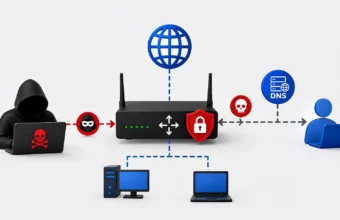
Finally, automated containment executes coordinated response actions across Defender components to isolate or disable compromised assets in real time, limiting further spread while preserving visibility for investigation.
Mitigation Mechanism
- Device isolation: compromised endpoints are disconnected from the enterprise network while retaining connectivity to Defender services for continued telemetry and remediation; isolation is time-limited and reversible by security teams.
- IP address containment: for unmanaged or non-onboarded devices, related IP addresses are blocked to prevent malicious traffic from spreading.
- Granular containment for critical assets: high-value systems (for example, domain controllers) can have specific ports or communication directions blocked rather than full network cuts, preserving essential business functions while stopping attack paths.
- Account suspension: Defender for Identity can automatically disable compromised user accounts in Active Directory, Microsoft Entra ID, or integrated identity providers, with role-based checks (RBAC) gating disablement to prevent unintended disruption.
Detection Mechanism
Automated decisions rely on ensemble machine-learning models that include graph models, boosted decision trees, neural networks, and small language models trained on correlated telemetry, threat intelligence, and prior incident analyses.
Microsoft reports automated containment actions operate at 99% or higher confidence under production telemetry. Detectors are validated in audit mode before rollout.
Security teams continuously monitor disruption activity to reduce false positives and preserve detection quality over time, with 24/7 operational coverage for anomalous behavior.
Human oversight remains central: security operations retain full control, all automated actions are reversible, and changes are surfaced in incident queues with visual indicators such as attack disruption tags, status banners, and updated asset status in the incident graph.
Organizations can configure selective exclusions for devices, IPs, or device groups to preserve essential management and business communications and to prevent designated critical systems from being auto-isolated.
Enabling or tuning automatic disruption requires reviewing device group policies and remediation levels in the Defender portal; administrators need Global Administrator or Security Administrator roles in Microsoft Entra ID to configure automated response exclusions.
Automated activities are logged in the Action Center and incident timelines so teams can review the full attack chain and the sequence of automated responses.






No Comment! Be the first one.