
Microsoft Gets LG to Disable McAfee Pop-Ups Triggered by Windows Update Monitor App

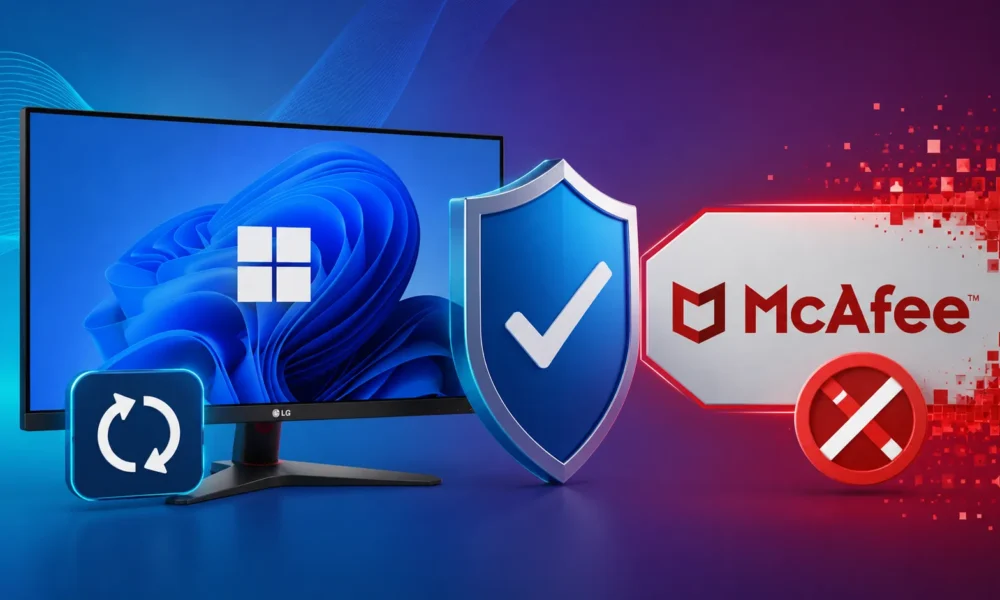
Microsoft has confirmed that LG has agreed to disable an unsolicited McAfee promotional pop-up delivered through its LG Monitor App Installer, following widespread criticism from users who reported the software appearing after routine Windows Update processes.
The incident has reignited concerns over OEM companion applications, Windows device metadata distribution, and the growing debate around software transparency and user consent.
While Microsoft acted quickly to coordinate a fix with LG, the controversy has highlighted how legitimate operating system mechanisms can be leveraged to distribute promotional software without providing users with clear visibility or meaningful control.
Microsoft Gets LG to Disable McAfee Pop-Ups
The issue first surfaced when Reddit user Mags_Smash reported that connecting three LG UltraGear monitors caused Windows Update to silently install the LG Monitor App Installer.
Shortly after installation, the application displayed a McAfee 30-day trial promotion despite no visible consent dialog or installation prompt being presented to the user.
Investigation of Windows Reliability Monitor and Event Viewer logs indicated that the installation originated from a background Windows Update process rather than any manual software download or deliberate user interaction.
The discovery quickly spread across online communities, prompting further independent testing by security researchers and technology journalists.
Subsequent testing reproduced the behavior on an LG UltraGear 34GX900A-B gaming monitor priced at approximately $1,200, where the McAfee promotional pop-up appeared on 31 of 32 consecutive system boot cycles.
Researchers also discovered that the LG Monitor App Installer’s own release notes referenced McAfee as an “Additional App” bundled within a recent software update alongside marketing material advertising a free 30-day trial.
These findings appeared inconsistent with LG’s later public statements, which claimed that McAfee software required explicit user approval before installation.
As evidence accumulated, the application’s Microsoft Store rating rapidly declined to a single star, reflecting widespread dissatisfaction among Windows users.
The controversy reached senior Microsoft leadership after Epic Games CEO Tim Sweeney publicly tagged Pavan Davuluri, Executive Vice President of Microsoft’s Windows and Devices division, on social media on July 19, 2026.
Sweeney highlighted reports suggesting that promotional software could be triggered by simply connecting compatible hardware, raising concerns that similar behavior might extend beyond LG devices.
Within hours, Davuluri acknowledged the reports and confirmed that Microsoft’s engineering teams were actively investigating the matter. By July 22, Microsoft announced it had contacted LG directly to address the issue.
In an official statement, Davuluri confirmed that LG had agreed to disable the McAfee promotional pop-up from the LG Monitor App Installer as an immediate mitigation measure.
He thanked the community for bringing the issue to Microsoft’s attention and emphasized the company’s commitment to improving the Windows hardware ecosystem alongside OEM partners.
The rapid response was notable, particularly given that disputes involving software bundling between major hardware manufacturers and operating system vendors often require extended negotiations before changes are implemented.
LG later released its own statement asserting that McAfee is not installed automatically and is never installed without explicit user consent.
The company argued that Microsoft’s official Windows software distribution process merely presented McAfee as an optional component rather than forcing installation.
However, this explanation conflicted with user-recorded evidence, Windows diagnostic logs, and the application’s published changelog, all of which suggested that promotional content was delivered automatically after hardware detection.
Although the McAfee software itself may not have been fully installed without user interaction, security analysts noted that unsolicited promotional pop-ups alone can undermine user trust and create confusion regarding software provenance and system integrity.
From a cybersecurity perspective, the incident highlights broader concerns surrounding the Windows Device Metadata Retrieval Client and companion application distribution pipeline.
Microsoft allows hardware manufacturers to automatically deploy supporting applications when compatible peripherals are connected, streamlining driver installation and device configuration.
While designed to improve usability, the mechanism can also introduce unnecessary software, promotional content, or OEM-specific utilities that users never intentionally requested.
Similar behavior has previously been observed with vendors such as Razer, whose peripherals automatically trigger installation of Synapse management software through Windows Update.
By comparison, macOS does not currently provide an equivalent mechanism allowing connected peripherals to automatically initiate App Store software deployments.
The LG-McAfee incident also reinforces Microsoft’s longstanding recommendation that Microsoft Defender provides sufficient baseline protection for most Windows 11 users, reducing the need for third-party antivirus trials bundled through OEM applications.
For enterprise defenders and IT administrators, the case serves as a reminder to monitor software deployed through Windows Update, audit companion applications introduced via connected hardware, and review OEM provisioning policies within managed environments.
Although Microsoft and LG resolved the issue within approximately one week of public disclosure, the incident underscores the importance of transparent software distribution practices and maintaining user trust across the Windows ecosystem.



No Comment! Be the first one.