
HardBreacher PoC Allegedly Exploits Kaspersky Endpoint Security Privilege Escalation Flaw

A newly published proof of concept (PoC), dubbed HardBreacher, allegedly targets an unpatched local privilege-escalation vulnerability in Kaspersky Endpoint Security for Windows.
The code, released on GitHub by a user identified as MSNightmare, is being described as a potential zero-day; however, Kaspersky has not publicly confirmed the vulnerability, its impact, or affected product versions.
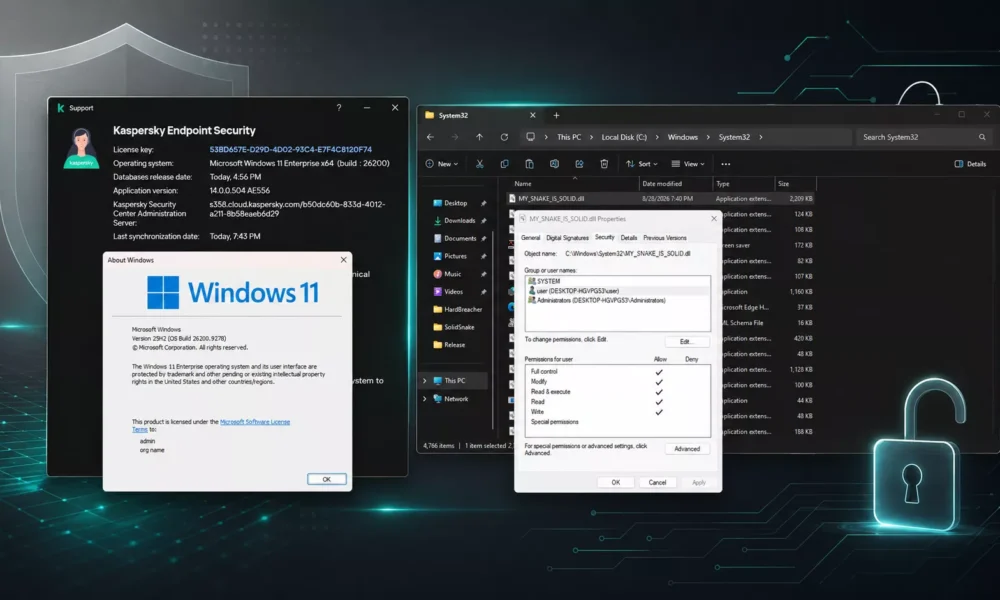
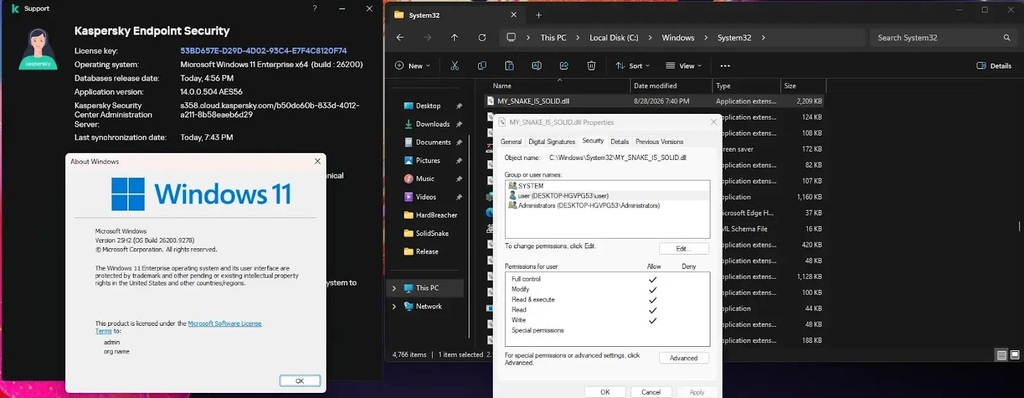
According to the project’s GitHub README, HardBreacher was tested against a fully patched Windows 11 system running Kaspersky for Endpoint version 14.0.0.504.
The repository claims that the vulnerability allows a standard local user to gain control of a privileged product component, creating a potential path to SYSTEM-level access.
HardBreacher PoC Allegedly Exploits Kaspersky Endpoint Security
The author states that successful exploitation causes the creation of a DLL file at:
C:\Windows\System32\MY_SNAKE_IS_SOLID.dll
The file is reportedly created with permissions that grant full access to the unprivileged user. If verified, this behavior could allow a local attacker to abuse privileged file operations and potentially execute code, alter protected system resources, or interfere with endpoint protection functionality.
HardBreacher should not be considered a remote initial-access exploit. An attacker would first need local code execution or access to a valid user account on the targeted device. Nevertheless, local privilege escalation vulnerabilities remain highly valuable in real-world intrusions.
Threat actors commonly combine them with phishing-delivered malware, malicious software installers, stolen credentials, or compromised remote-access accounts to move from a low-privileged foothold to administrative or SYSTEM-level control.
SYSTEM-level execution can significantly expand an attacker’s options. A successful elevation could enable the disabling or tampering of security controls, access to protected files and credentials, deployment of persistence mechanisms, and theft of tokens or secrets that may support lateral movement across a corporate environment.
Devices used by administrators, developers, and employees with access to sensitive data could present a particularly attractive target. The HardBreacher author acknowledges that the current PoC is unreliable.
The code may generate errors, fail during execution, or require repeated attempts. However, instability should not be interpreted as a security control.
Public PoC availability lowers the barrier for researchers and adversaries to inspect the affected attack surface, improve exploit reliability, and potentially integrate the technique into multi-stage attack chains.
The README further claims that obtaining control over Kaspersky’s user interface component can destabilize the product’s functionality.
This could allegedly result in unexpected file-access decisions and disruption of security features. These claims remain unverified, and independent technical validation was not available at the time of reporting.
Organizations should treat HardBreacher as an unconfirmed but potentially significant security concern until Kaspersky issues an advisory, CVE assignment, detection guidance, or software update.
Security teams should immediately inventory endpoints running Kaspersky Endpoint Security for Windows, particularly systems using version 14.0.0.504, and preserve information on installed versions, endpoint policies, and recent configuration changes.
Administrators should not execute the public PoC on production devices. As a precaution, defenders should enforce least-privilege controls, reduce unnecessary interactive access for standard users, and investigate anomalous file writes or permission modifications within C:\Windows\System32.
Detection teams should also review telemetry for unexpected child processes launched by Kaspersky user-interface components, interruptions to security services, abrupt policy changes, and DLL creation within protected Windows directories.
Establishing a baseline of legitimate Kaspersky processes before deploying alerts can help reduce false positives. Until the vendor validates the issue and releases remediation, organizations should prioritize strict local-access controls, heightened endpoint monitoring, and rapid triage of activity involving protected operating-system paths.




No Comment! Be the first one.