
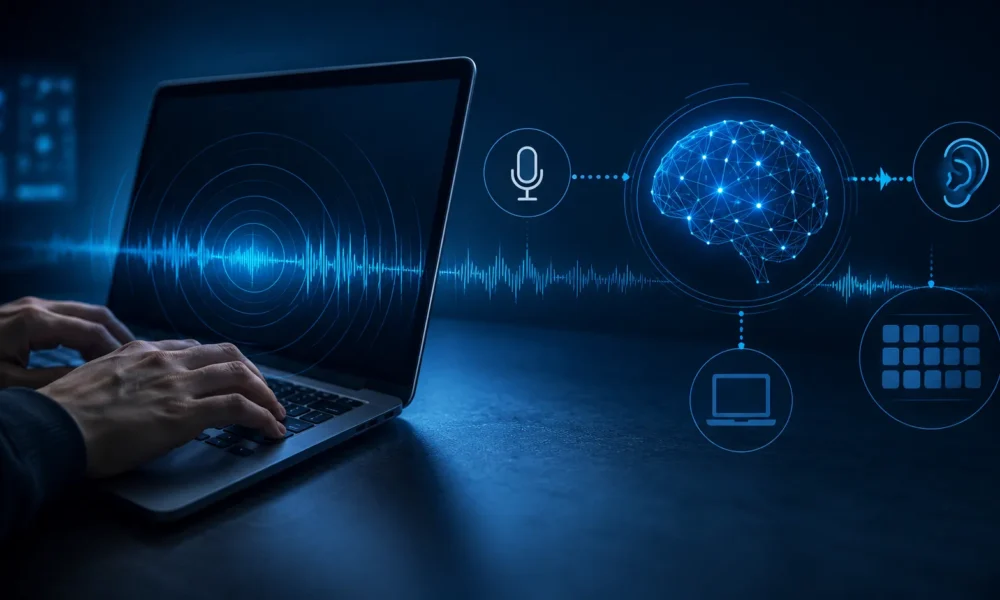
Cybersecurity researchers have demonstrated a sophisticated AI-assisted acoustic side-channel attack capable of reconstructing text typed on laptop keyboards by analyzing the sounds and vibrations generated during keystrokes.
Detailed in a recent arXiv research paper, the attack introduces a self-supervised machine learning framework that eliminates one of the biggest limitations of previous keyboard eavesdropping techniques, the need for pre-collected, device-specific training data.
The breakthrough significantly increases the practicality of acoustic surveillance attacks and raises new concerns about information leakage in offices, remote work environments, and online meetings.
AI Acoustic Attack Reconstructs Laptop Keystrokes
Traditional acoustic keyboard attacks typically require attackers to train machine learning models using labeled audio samples collected directly from the victim’s keyboard.
This requirement has made real-world exploitation difficult because attackers rarely have access to a target’s device before launching an attack.
The newly proposed approach overcomes this obstacle by automatically learning the relationship between keyboard sounds and typed characters without requiring labeled datasets. Instead of relying on supervised classification, the system combines unsupervised learning with modern language models to infer keyboard mappings dynamically.
The attack pipeline integrates several advanced artificial intelligence techniques, including acoustic feature extraction, unsupervised clustering, a character-level BERT language model, large language model (LLM)-based correction, and iterative feedback learning.
Rather than attempting to identify every keystroke independently, the system groups acoustically similar key presses into clusters and uses linguistic context to estimate the most likely characters.
As additional typing data becomes available, the AI continuously refines its understanding of the keyboard layout, steadily improving reconstruction accuracy without requiring any prior knowledge of the victim’s hardware.
Researchers validated the technique using a controlled proof-of-concept experiment involving a 13-inch 2019 MacBook Pro. During testing, an iPhone 15 positioned beside the laptop recorded the typing sounds while the victim entered natural-language text.
The results demonstrated remarkable performance, with the AI achieving approximately 99% text reconstruction accuracy after observing only 100 keystrokes, equivalent to roughly 17 words.
After collecting around 150 keystrokes, reconstruction accuracy increased to 99.33%, outperforming earlier Hidden Markov Model (HMM) and dictionary-based methods that required significantly more observations or produced lower accuracy under similar conditions.
To evaluate the technique across different hardware platforms, researchers expanded testing to include the Dell Latitude 7320, HP OmniBook X14, Lenovo ThinkPad X390, and additional MacBook Pro models.
Despite differences in keyboard construction, chassis materials, and acoustic characteristics, the AI consistently achieved high reconstruction accuracy after approximately 150 observed keystrokes.
These findings suggest that the attack is not limited to a single laptop design but can generalize across a wide range of commercially available devices.
Beyond direct microphone recordings, the study also explored structure-borne vibration attacks. In one experiment, attackers placed a contact microphone approximately three meters away on the same desk surface as the victim’s laptop.
Instead of capturing airborne sound, the sensor recorded vibrations transmitted through the desk. Even under these conditions, the AI successfully reconstructed typed text with high accuracy after collecting between 150 and 250 keystrokes, depending on the laptop model.
This demonstrates that physical vibration leakage can serve as an effective side channel even when conventional microphones are not positioned nearby.
Researchers further demonstrated that the attack remains viable through walls. A contact microphone attached to a wall successfully detected vibrations generated by a laptop positioned on the opposite side.
The MacBook Pro achieved over 95% reconstruction accuracy after approximately 150 keystrokes, while other tested laptops generally required between 200 and 250 keystrokes to reach similar performance.
Although walls introduced additional signal attenuation and noise, they did not eliminate the information leakage channel, highlighting the resilience of vibration-based attacks.
The research also examined online meeting platforms as potential attack vectors. Tests involving Google Meet, Microsoft Teams, and Zoom were conducted with noise suppression and echo cancellation disabled.
Under these conditions, the reconstructed text frequently exceeded 90% accuracy after approximately 150 to 250 keystrokes.
While reconstruction performance varied across conferencing platforms and laptop models, the findings indicate that remote meeting audio can unintentionally preserve sufficient keystroke information for AI-assisted inference attacks when audio processing features are weakened or disabled.
Password recovery proved more difficult because randomly generated passwords lack the grammatical patterns that language models use to improve prediction accuracy.
Nevertheless, researchers found that earlier natural-language typing within the same session could serve as self-supervised training data.
After observing approximately 426 natural-language keystrokes, the AI correctly ranked a five-character lowercase password as its top prediction in roughly 40% of trials, while placing the correct password within its top 100 candidates in nearly 90% of cases.
The study underscores the growing cybersecurity risks posed by AI-enhanced side-channel attacks. Organizations should recognize keyboard acoustics as a legitimate source of sensitive information leakage and implement defensive measures such as enabling strong noise suppression by default.
Muting microphones or using push-to-talk while entering confidential information, positioning microphones away from keyboards, and using desk mats or vibration-isolating materials to reduce acoustic and structural signal transmission.
As artificial intelligence continues to improve signal analysis capabilities, protecting against non-traditional side-channel attacks will become an increasingly important component of enterprise security strategies.






No Comment! Be the first one.