
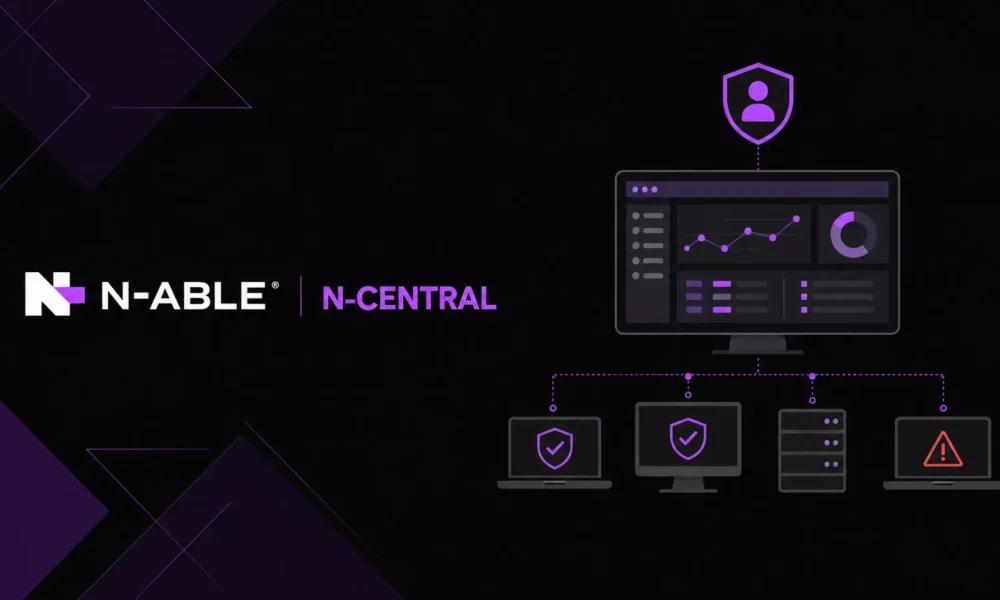
N-able has confirmed active exploitation of a critical vulnerability in N-central, its widely deployed remote monitoring and management (RMM) platform, granting attackers unauthenticated administrative access to the console MSPs use to oversee endpoints across all their customers.
The flaw affects every currently supported version of N-central, including 2026.3, spanning both cloud-hosted and on-premises deployments. N-able released an emergency hotfix, version 2026.3.1.7, on August 2, urging all customers to upgrade immediately.
Critical N-able N-central Flaws Actively Exploited
The vulnerability, tracked as CVE-2026-18556 alongside a related bypass, CVE-2026-18577, stems from an incomplete patch that enables authentication bypass and full account takeover.
Because N-central sits at the center of MSP operations, a compromised server becomes a force multiplier. Attackers gaining access can push scripts, deploy dual-use tools, and open remote-control sessions across every downstream endpoint the platform manages, turning a single breach into an enterprise-wide incident.
Security firm Huntress, tracking exploitation alongside N-able’s disclosures, reported observing active abuse affecting at least one customer environment. The attack chain leverages N-central’s built-in Take Control feature to pivot from console access into managed endpoints.

Huntress also found that several IPs N-able initially flagged as malicious actually trace back to VPN exit nodes operated by NordVPN and Mullvad, complicating attribution efforts. One address, however, had a documented prior history of brute-forcing and spam campaigns, suggesting genuine malicious infrastructure mixed in with VPN noise.
As of the latest update, more than half of reachable N-central cloud servers monitored by Huntress remained unpatched. This exposure gap is compounded by the fact that N-able’s appliance runs a custom AlmaLinux 9 distribution, which typically lacks endpoint detection and response (EDR) coverage, leaving compromises harder to detect through standard security tooling.
Mitigations
N-able and Huntress are urging MSPs to apply the 2026.3.1.7 hotfix without delay and to treat the console itself as a high-value target requiring hardening. Recommended steps include:
- Restrict N-central access from the public internet
- Enforce multi-factor authentication on all accounts
- Limit logins to known, trusted IP ranges
- Audit recent account changes, new administrative users, and remote-control sessions for signs of compromise
- Take N-central offline temporarily if immediate patching or isolation isn’t feasible
Detection efforts should focus on N-central’s UI and remote-access logs, correlating suspicious sessions with known indicator IPs and support-account misuse, alongside endpoint artifacts left by Take Control activity on Windows systems.
Indicators of Compromise (IOCs)
| Indicator | Description |
|---|---|
| 173.249.252[.]200, 87.249.138[.]34, 37.19.210[.]32, 68.235.46[.]214 | Malicious IPs flagged in N-able’s August 1 advisory; associated with Mullvad VPN or NordVPN exit nodes |
| 37.153.90[.]88, 92.118.112[.]181 | Malicious IPs flagged in N-able’s August 2 advisory |
| mousears.synology[.]me, wagoosh.direct.quickconnect[.]to, who-ripped-one.direct.quickconnect[.]to | Malicious domains linked to the campaign |
MSPs running N-central should treat this as an urgent priority given the platform’s privileged position across client environments a single unpatched instance can cascade into compromise across dozens of downstream organizations.





No Comment! Be the first one.