
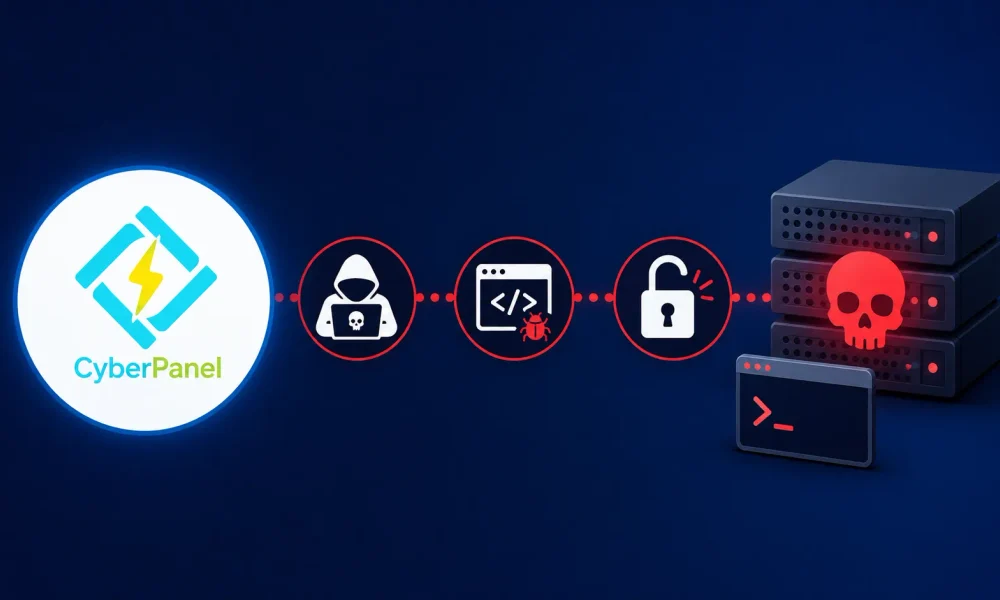
A newly disclosed chain of pre-authentication remote code execution vulnerabilities in CyberPanel could allow unauthenticated attackers to compromise exposed web hosting servers.
Named “ShadowPanel” by Pentera researcher Nir Chako, the attack combines weaknesses in CyberPanel’s AI Scanner component with its built-in cron-job functionality to progress from unauthenticated access to host-level command execution.
The vulnerabilities are particularly significant because CyberPanel operates as an administrative control layer for websites, DNS configurations, email accounts, databases, users, and scheduled operating-system tasks.
CyberPanel ShadowPanel RCE Chain
The ShadowPanel attack chain affects CyberPanel version 2.4 and demonstrates how multiple individually limited weaknesses can become a complete server compromise when combined.
The initial stage targets exposed AI Scanner interfaces. Researchers identified unauthenticated debug API routes, including /api/ai-scanner/list-api-keys, that could disclose information about recent scanning activity.
Among the exposed information were valid scan identifiers, or scan_id values, which play an important role in CyberPanel’s AI Scanner callback process.
After obtaining a legitimate scan identifier, an attacker can interact with vulnerable worker endpoints and submit attacker-controlled information to the application without first authenticating to the CyberPanel management interface.
CVE-2026-41473 tracks an authentication bypass affecting the AI Scanner worker API. Vulnerable endpoints reportedly include /api/ai-scanner/status-webhook and /api/ai-scanner/callback, where incoming requests were not sufficiently authenticated or authorized.
This weakness allows remote attackers to write arbitrary content into scan-related database records without possessing a CyberPanel account or administrator credentials.
The ability to manipulate stored application data becomes particularly dangerous because the attacker can use it to prepare the next stage of the exploitation chain.
The second stage involves CVE-2026-41472, a stored cross-site scripting vulnerability affecting the AI Scanner dashboard.
By abusing the unauthenticated callback functionality, an attacker can inject malicious JavaScript into fabricated scan findings.
CyberPanel stores these findings in its database and subsequently displays them through the AI Scanner interface without adequately escaping untrusted content.
When an administrator accesses the manipulated scan results, the injected JavaScript executes within the administrator’s authenticated browser session.
This effectively allows the attacker to perform actions with the privileges of the logged-in administrator. In Pentera’s proof of concept, researchers used the browser-based access to create a new CyberPanel administrator account, transforming the stored XSS vulnerability into persistent privileged access to the control panel.
The final stage abuses CyberPanel’s legitimate cron-job management functionality. Cron jobs are intended to allow administrators to schedule operating-system commands, but once an attacker obtains privileged CyberPanel access, the same capability can become an avenue for server-level command execution.
Researchers demonstrated that malicious scheduled tasks could be created to execute commands and establish a reverse shell on the vulnerable host.
The ShadowPanel chain highlights why security teams should evaluate vulnerabilities based on their potential for combination rather than considering each weakness independently.
An exposed debug interface can provide reconnaissance data, an authentication bypass can enable unauthorized database modification, stored XSS can compromise an administrator session, and privileged cron functionality can ultimately provide operating-system-level execution.
Pentera reported the vulnerabilities to CyberPanel on May 4, 2026. CyberPanel reportedly released fixes within approximately four hours, including removal of vulnerable debug endpoints, stronger callback authentication, and improved output escaping.
Administrators should upgrade to the latest patched CyberPanel release immediately. Until updates are applied, organizations should restrict access to the management interface, disable AI Scanner where practical, and investigate suspicious callbacks, modified scan results, unexpected administrator accounts, and unauthorized cron jobs.
Because CyberPanel provides centralized control over critical hosting services, exposed instances should be treated as high-value targets requiring immediate defensive attention.




No Comment! Be the first one.