
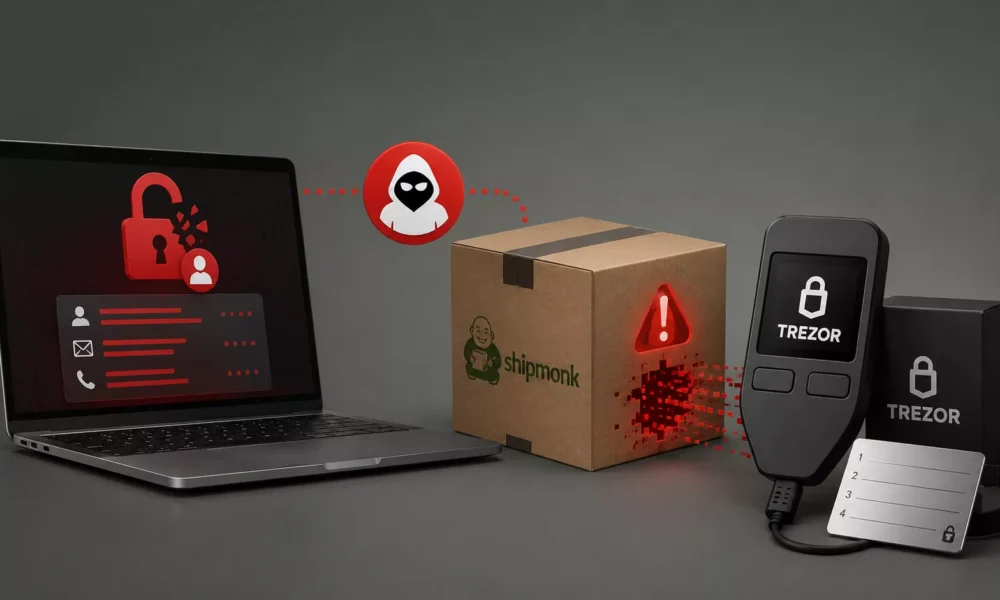
Hardware wallet manufacturer Trezor has disclosed a third-party data breach affecting approximately 13,689 customers after unauthorized actors accessed systems operated by its shipping and fulfillment provider, ShipMonk.
The incident has exposed order-related personal information and raises serious concerns about targeted phishing, social engineering, and physical-world fraud against cryptocurrency holders.
ShipMonk notified Trezor about the unauthorized access on August 10, 2026. Trezor said the investigation remains ongoing but emphasized that the compromise occurred inside ShipMonk’s environment, not in Trezor’s own infrastructure.
Trezor ShipMonk Data Breach
The company said its hardware wallets, products, services, and customers’ wallet backups remain secure. The breach affects customers in the United States, United Kingdom, Sweden, Colombia, Brazil, Italy, and Portugal. Trezor initially identified orders received between May 10 and August 8, 2026, as part of the affected dataset.
Of the 13,689 affected individuals, 11,742 reportedly had their names, email addresses, phone numbers, and shipping addresses exposed.
A further 1,947 customers had a narrower set of data exposed, consisting of their name, city, and email address. Trezor said this partially exposed group could include older orders and that it is verifying the precise scope and period with ShipMonk.
Although Trezor said wallet backups and recovery seeds were not exposed, the leaked fulfillment information remains valuable to financially motivated attackers.
A confirmed list of likely hardware-wallet owners, especially one paired with home addresses, phone numbers, and email accounts, can enable far more convincing scams than broad, untargeted cryptocurrency phishing campaigns.
Threat actors can use the exposed data to impersonate Trezor support, cryptocurrency exchanges, shipping services, banks, or payment providers. Because attackers may know a target’s identity, location, contact information, and probable Trezor ownership, they can personalize fraudulent messages in a way that appears legitimate.
For example, a victim may receive an email or SMS claiming that their recent Trezor order requires a “security validation,” delivery confirmation, account verification, or firmware update.
The message could redirect the victim to a cloned Trezor website designed to capture a wallet recovery seed. Once attackers obtain a recovery seed, they can restore the wallet elsewhere and transfer the victim’s crypto assets without needing to steal the physical device.
Trezor has reiterated that customers must never enter a wallet backup or recovery seed into a website, application, email form, or support chat. A legitimate Trezor representative, exchange, bank, or delivery provider should never request a user’s recovery seed, PIN, or passphrase.
Trezor attributed the incident’s limited scope to its 90-day order-data retention policy. The company requires fulfillment partners to delete or anonymize customer data after delivery-related functions, such as returns, refunds, and replacements, are completed. Trezor said older records were no longer present in ShipMonk systems and therefore could not have been exposed.
However, the presence of 1,947 customers with partially exposed details shows why supplier data-retention policies must be continuously verified.
Third-party risk management cannot rely only on contractual language or stated retention commitments. Organizations handling sensitive customer data need evidence that suppliers are enforcing retention periods, securely deleting information, restricting access, logging activity, and promptly reporting suspicious events.
Affected users should treat unexpected Trezor-related support requests, delivery notices, account-verification prompts, and urgent cryptocurrency-security alerts as potentially malicious.
Communications should be independently verified through Trezor’s official website, blog, and authenticated social channels rather than through links or phone numbers included in an unsolicited message.
Users should avoid clicking links in unexpected emails or SMS messages and should carefully inspect web addresses before entering credentials or device-related information. Monitoring email accounts, phone calls, and physical mail for suspicious activity is also prudent, as attackers may attempt multi-channel social-engineering campaigns.
For future hardware-wallet orders, customers may wish to use a dedicated email address and consider privacy-preserving payment and delivery options where available.
The breach demonstrates that crypto security extends beyond wallet firmware and private keys: purchase records and fulfillment metadata can become a high-value intelligence source for attackers seeking to identify and manipulate digital-asset holders.


No Comment! Be the first one.