
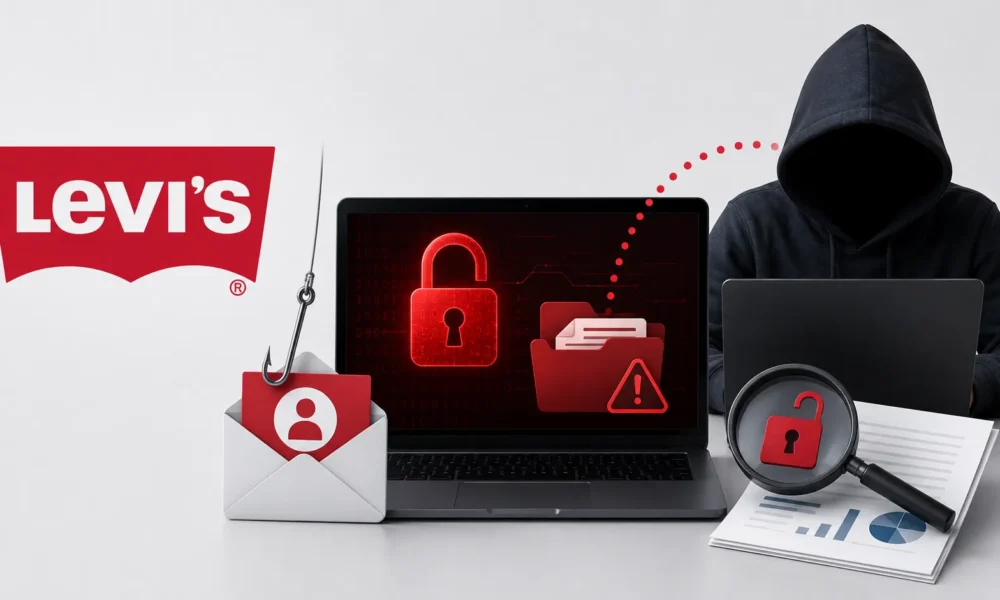
Levi Strauss & Co. has disclosed a cybersecurity incident involving a targeted social engineering attack that resulted in the compromise of three employee-issued computers and the exfiltration of unspecified corporate data.
The incident highlights the growing effectiveness of identity-based attack techniques, where adversaries manipulate individuals rather than exploiting software vulnerabilities to gain access to enterprise environments.
According to the company, the breach has been contained, and there is currently no evidence that customer data was impacted or that business operations were disrupted.
Levi Strauss Cyberattack via Social Engineering
The disclosure was made through a Form 8-K filing with the U.S. Securities and Exchange Commission on August 7, where Levi Strauss confirmed that unauthorized access to internal files was detected following a social engineering intrusion.
While the company has not provided a detailed timeline of the attack or identified the threat actors involved, it acknowledged that employees were manipulated through undisclosed techniques that enabled attackers to access corporate systems.
This lack of specificity underscores the complexity of modern social engineering campaigns, which often combine multiple tactics such as phishing, voice phishing, and impersonation.
Upon detecting the breach, Levi Strauss activated its incident response procedures and implemented containment measures to prevent further unauthorized access.
The company also engaged external cybersecurity experts to support the investigation and remediation process. According to the filing, the response actions were effective in terminating the intrusion based on the information available at the time.
However, the organization has indicated that its investigation is ongoing, and additional details may emerge as forensic analysis progresses.
The compromise of just three employee devices was sufficient to provide attackers with access to corporate information, demonstrating how even limited entry points can lead to broader security risks.
Social engineering attacks often bypass traditional security controls by exploiting human behavior, enabling attackers to gain credentials, approve authentication requests, or install malicious tools without triggering conventional defenses.
In this case, Levi Strauss did not disclose whether the attackers used phishing emails, SMS-based lures, help desk impersonation, or multi-factor authentication fatigue techniques, leaving open the possibility that multiple vectors were involved.
Preliminary findings suggest that certain corporate data was accessed and exfiltrated, although the company has not specified the nature or sensitivity of the information. It remains unclear whether the affected data includes intellectual property, financial records, internal communications, or employee information.
Additionally, there is no indication that ransomware was deployed or that the attackers issued extortion demands, which may suggest that the objective was limited to data theft rather than disruption or financial coercion.
Despite the breach, Levi Strauss has stated that it does not expect the incident to have a material impact on its business operations, financial condition, or long-term strategy.
The company also confirmed that it is in the process of notifying affected parties and regulatory authorities where required.
These notifications may evolve as investigators gain a clearer understanding of the scope of the incident and any potential downstream impacts.
The incident serves as a reminder that traditional perimeter defenses and endpoint protections are not sufficient to prevent modern cyber threats.
As attackers increasingly focus on identity-driven intrusion methods, organizations must strengthen their human-centric security controls.
This includes implementing phishing-resistant multi-factor authentication, enhancing identity verification processes for help desk interactions, segmenting privileged access, and deploying advanced endpoint detection and response solutions.
For incident response teams, rapid action is critical following a suspected social engineering compromise. Immediate steps should include revoking active sessions, resetting credentials, isolating affected devices, and analyzing authentication and endpoint telemetry for signs of lateral movement.
Organizations should also review data access logs to determine whether sensitive information was accessed or exfiltrated.
As the investigation continues, Levi Strauss’s experience underscores the importance of combining technical defenses with robust user awareness and identity protection strategies.
In an era where human factors are often the weakest link, proactive measures to detect and mitigate social engineering attacks are essential for maintaining organizational security.



No Comment! Be the first one.