
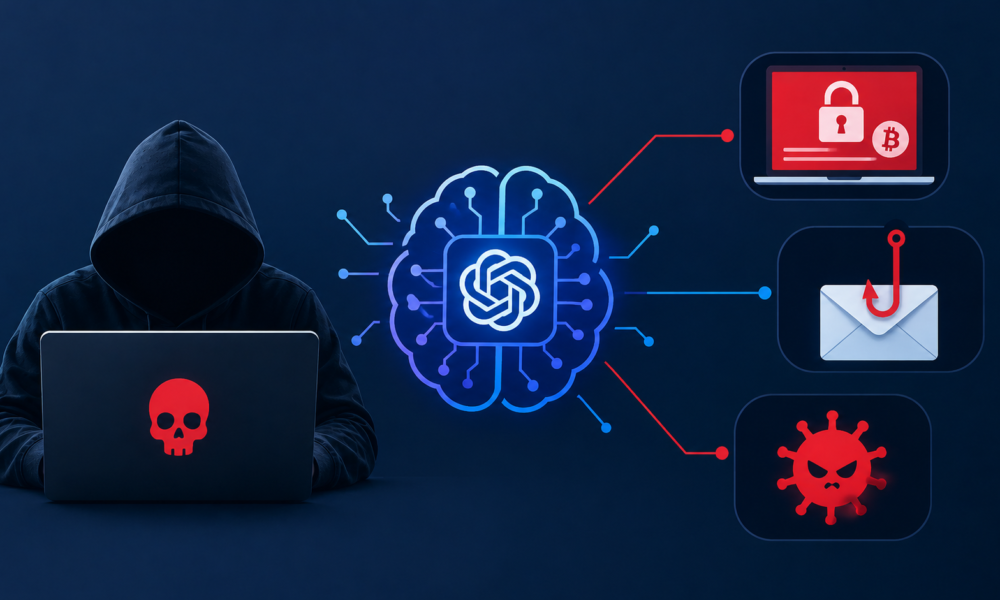
A newly identified criminal artificial intelligence service called MessiahGPT is being marketed as an unrestricted platform for generating ransomware, phishing kits, information stealers, crypters, rootkits, and other malicious content.
According to research from the Trellix Advanced Research Center, the service represents an evolution in the underground AI ecosystem, moving beyond individual jailbreak attempts toward a commercial, subscription-based model designed to lower the technical barriers to cybercrime.
MessiahGPT is reportedly promoted through criminal forums and operates through a public-facing website and Telegram community.
MessiahGPT Criminal AI Tool
MessiahGPT’s operators reportedly advertise the service as being powered by a custom Mixture-of-Experts model containing 128 experts, with 16 experts activated for each token.
The operators further claim that the model does not use safety mechanisms such as Reinforcement Learning from Human Feedback or Constitutional AI.
They also claim that the system was trained using unrestricted manuals, dark-web archives, leaked documents, and unfiltered web information.
However, these technical and training claims originate from the service’s operators and have not been independently validated, meaning defenders should distinguish between advertised capabilities and capabilities demonstrated through reliable testing.
The service’s commercial structure is particularly significant from a cybersecurity perspective. MessiahGPT allegedly provides prospective users with 50 anonymous trial queries before requiring a paid subscription, with pricing reportedly starting at approximately $8 per month.
Cryptocurrency payments and the absence of know-your-customer requirements further reduce barriers for individuals seeking access. Advertisements associated with the service reportedly promote the creation of compilable malware, phishing infrastructure, social-engineering material, and other criminal resources.
This creates the possibility that inexperienced threat actors could use AI assistance to develop or modify malicious campaigns without possessing advanced programming or security expertise.
AI assistance could potentially accelerate several stages of an attack. Low-skilled criminals may use such services to generate code, customize phishing messages, translate malicious communications, develop social-engineering scenarios, or rapidly create variations of existing campaigns.
AI-generated payloads, however, should not automatically be considered sophisticated or effective. Generated code can contain errors, produce detectable artifacts, or fail against modern security controls.
Likewise, claims about an AI model’s ability to create advanced malware do not constitute proof that the resulting payload can successfully compromise real-world environments.
For defenders, focusing exclusively on identifying “AI-generated malware” would be ineffective because reliably determining whether malicious code was created by an AI system is difficult.
Security teams should instead prioritize observable behaviors associated with attacks. Important indicators include suspicious identity-provider authentication, unexpected mailbox-rule creation, credential-harvesting infrastructure, abnormal endpoint process chains, mass file modifications, unauthorized encryption activity, and unusual outbound network connections.
Behavioral detection can remain effective regardless of whether the attacker wrote the malicious content manually or generated it using an AI service.
Organizations should strengthen their defensive layers by implementing SPF, DKIM, and DMARC protections, phishing-resistant multifactor authentication, URL filtering, attachment analysis, endpoint detection, network monitoring, and tested offline or immutable backups.
Security operations teams should correlate DNS, proxy, endpoint, and identity telemetry to identify suspicious infrastructure and unusual egress activity.
Newly registered domains and rapidly changing infrastructure should receive particular attention because criminal operators can move services quickly after domains or servers are blocked.
Threat-intelligence teams should monitor MessiahGPT and associated criminal channels for reliable indicators, advertisements, infrastructure information, and observed capabilities while clearly separating confirmed evidence from unverified operator claims.
Incident-response teams should also review ransomware procedures, validate endpoint isolation processes, and regularly rehearse recovery operations.
The emergence of MessiahGPT ultimately demonstrates a broader shift toward accessible automated offensive assistance.
Rather than depending on attackers making obvious mistakes, organizations should assume that malicious actors can cheaply produce convincing, variable, and personalized content.
Strong identity controls, behavioral detection, network segmentation, and resilient recovery capabilities therefore remain essential as AI continues to reshape the cybercrime ecosystem.






No Comment! Be the first one.